 FR
 EN
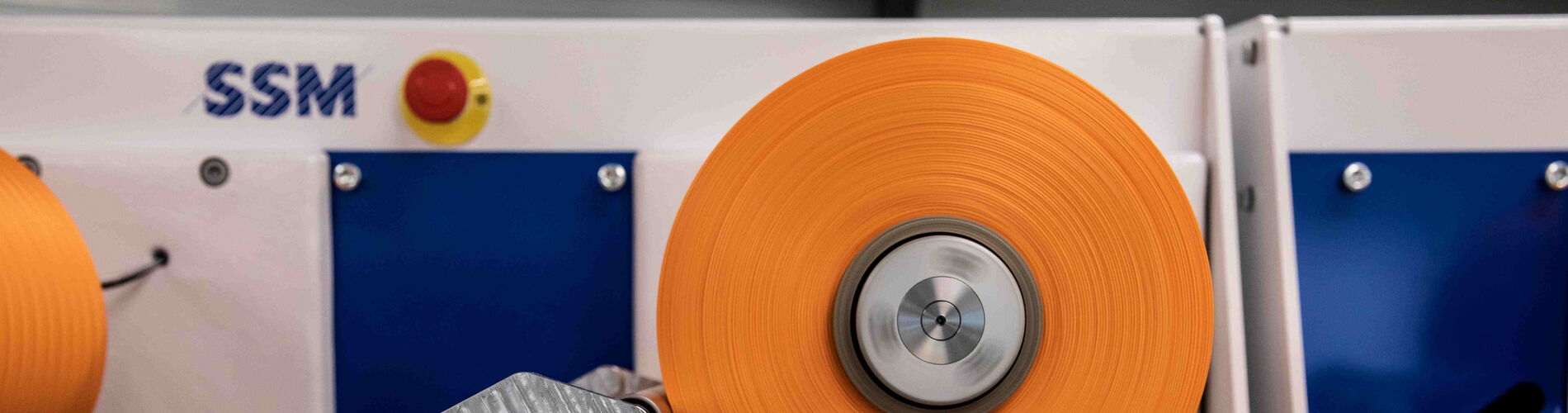
Assembly, winding, and twisting
Assembly
Assembly increases the diameter of the roving, which strengthens its resistance to breakage. Our equipment is capable of combining up to 25 parallel strands, without binding them together, to form a single roving. This step generally precedes the twisting process in order to provide the necessary cohesion for the final yarn. We also specialize in assembling yarns of different compositions, enabling the creation of hybrid metal yarns or combining, for example, polyester with other materials.
Winding
Technical winding is the stage at which the assembled yarn is packaged on suitable supports (cones, cylindrical or conical spools) according to strictly controlled parameters. This operation requires precise control of the winding tension, winding speed, and guidance system to ensure even distribution of the yarn on the support. The choice between cross-winding or parallel winding depends on the final application and subsequent unwinding constraints. High-quality winding prevents defects such as layer sinking, tension variations, or tangling, thus ensuring optimal use of the yarn during subsequent processing stages in filter manufacturing.
Twisting
Twisting gives the assembled yarn its final mechanical properties by applying a controlled rotation around its longitudinal axis, measured in turns per meter (T/m). This operation determines the cohesion between the constituent fibers, the tensile strength, the dimensional stability, and the surface characteristics of the yarn. The direction and intensity of the twist are calculated based on the desired final diameter, the nature of the assembled materials, and the intended filtration application. A balanced twist optimizes the internal structure of the yarn, promotes geometric regularity, and improves filtration performance by creating controlled porosity and mechanical strength adapted to industrial use constraints.